Scaling Employee Engagement During Rapid Enterprise Growth

Scaling Employee Engagement During Rapid Enterprise Growth

Scaling Employee Engagement During Rapid Enterprise Growth

CASE STUDY - EMPLOYEE EXPERIENCE

CASE STUDY - EMPLOYEE EXPERIENCE

Note: Actual examples given below.

Building an internal communication ecosystem for a rapidly expanding telecom program, helping remote teams stay informed, connected, and aligned.


At Tech Mahindra, I helped shape employee communication for a 1,600+ member account supporting Telefónica Germany through campaigns, leadership messaging, and engagement initiatives.

Building an internal communication ecosystem for a rapidly expanding telecom program, helping remote teams stay informed, connected, and aligned.


At Tech Mahindra, I helped shape employee communication for a 1,600+ member account supporting Telefónica Germany through campaigns, leadership messaging, and engagement initiatives.

Building an internal communication ecosystem for a rapidly expanding telecom program, helping remote teams stay informed, connected, and aligned.


At Tech Mahindra, I helped shape employee communication for a 1,600+ member account supporting Telefónica Germany through campaigns, leadership messaging, and engagement initiatives.

Project Overview

Role

Communications Manager

Scope

Internal communications strategy, employee engagement campaigns, leadership messaging, content creation

Users

1600+ employees across countries

Timeline

2021 - 2024

Industry

Telecom

Contribution

Communication strategy, plan and collaterals

S

Situation
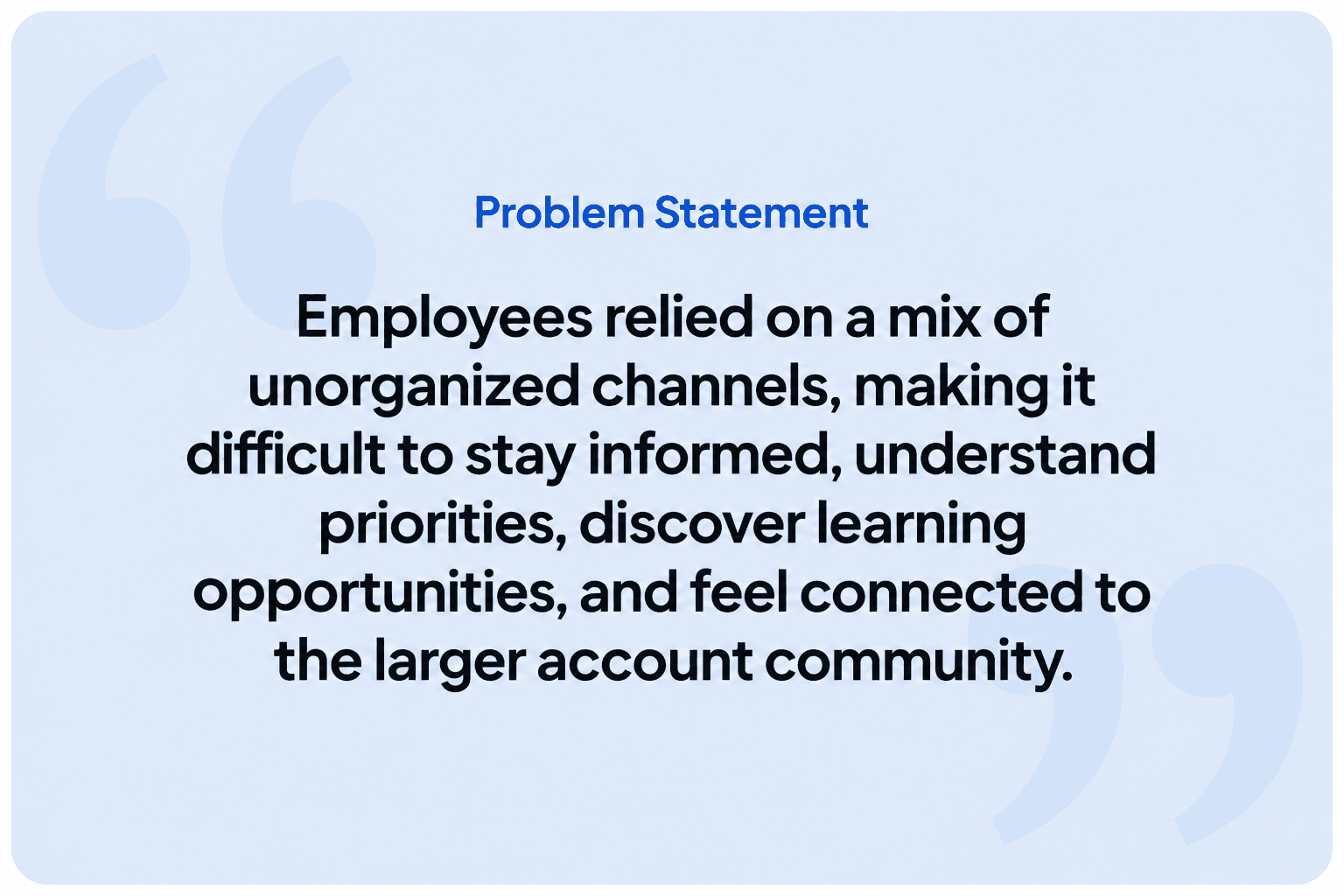
Background -

  • Multicultural team across 20+ cities globally.

  • Team formed post-COVID; remote working with minimal in-person interaction.

  • Complex project requiring highly skilled teams across multiple domains (OSS, BSS, Migration, Agile).

  • Build "One Team" culture, strengthen connection and drive engagement.

Background -

  • Multicultural team across 20+ cities globally.

  • Team formed post-COVID; remote working with minimal in-person interaction.

  • Complex project requiring highly skilled teams across multiple domains (OSS, BSS, Migration, Agile).

  • Build “One Team” culture, strengthen connection and drive engagement.

Target Audience / Users

Delivery Engineer

  • Project updates

  • Learning

  • Recognition

Project Manager

  • Leadership visibility

  • Project milestones

  • Customer updates

New Joiner

  • Onboarding

  • Account understanding

  • Community

Leadership

  • Consistent comms

  • Employee engagement

  • Account alignment

T

Task

Business Goal

Design and execute an engaging, scalable communication strategy that could support a rapidly growing remote workforce by:

Strengthening account identity

Improving knowledge sharing

Increasing leadership visibility

Fostering a stronger sense of community and belonging

Keeping employees aligned with business priorities

A

Action

My Key Responsibilities:

Defined the communication roadmap aligned with business priorities.

Planned and managed end-to-end communication campaigns.

Collaborated with business leaders, cross-functional teams and client counterparts to align communication initiatives with organizational goals and employee needs.

Liaised with business leaders, cross-functional teams and client counterparts to align communication initiatives with organizational goals and employee needs.

Measured engagement through employee feedback and participation trends.

Continuously refined initiatives based on employee insights and evolving business priorities.

My Design Approach

Communication Initiatives

Below given are some real instances of communication initiatives including - Leadership Messages, Newsletters, Special Campaigns (DATE - Words of Wisdom), Leadership Video Interviews and other event specific messages.


Note: To maintain confidentiality, all names, photographs, and identifiable references have been intentionally obscured throughout the examples below.

UX Principles Applied

Stakeholder Management, Content Strategy, Information Architecture, User Journey Thinking, Change Management and Experience Design

R

Result

Outcomes

Supported the communication needs of a rapidly growing account as the team expanded from approximately 150 to over 1,400 employees within six months while working remotely. 

Established consistent communication touchpoints for leadership updates, learning, recognition, and employee engagement. 

Improved visibility of account initiatives, project milestones, and leadership communication across geographically distributed teams. 

Enabled collaboration through joint initiatives such as combined town halls with client leadership. 

Enabled collaboration through joint initiatives such as combined town halls with client leadership. 

Employee Feedback

In Their Words…

Outcomes

Supported the communication needs of a rapidly growing account as the team expanded from approximately 150 to over 1,400 employees within six months while working remotely. 

Established consistent communication touchpoints for leadership updates, learning, recognition, and employee engagement. 

Improved visibility of account initiatives, project milestones, and leadership communication across geographically distributed teams. 

Enabled collaboration through joint initiatives such as combined town halls with client leadership. 

Key Learnings

  • Memorable employee experiences begin with thoughtful communication.

  • A communication strategy is more effective than isolated campaigns.

  • Different employee groups have different information needs throughout their journey.

  • Clear information architecture and visual storytelling reduce complexity.

  • Leadership visibility and continuous learning strengthen engagement in distributed teams.

  • This project reinforced that understanding people, their needs, and their context is at the heart of good design - an insight that inspired my transition into UX.

How I Would Approach This Today as a UX Designer

If I were to recreate this exercise today, I would combine my communication strategy experience and knowledge from HFI Certified Usability Architect (CUA™) to create a more research-driven employee experience.


1. Understand users - Conduct interviews and surveys across employee groups to uncover information needs, behaviours, and pain points.


2. Map the experience - Create employee journey maps to identify communication gaps across onboarding, learning, collaboration, and day-to-day work.


3. Design the information architecture - Organise content around employee goals and tasks, making critical information easier to discover while reducing information overload.


4. Prototype and validate - Test communication touchpoints and digital experiences through wireframes and prototypes before implementation.


5. Measure outcomes - Track both engagement and usability using qualitative feedback and quantitative metrics to continuously improve the experience.

Employee Feedback

Here are the most followed communications campaigns and the aspects that were valued most about them.

Survey Results

In Their Words…

Key Learnings

  • Memorable employee experiences begin with thoughtful communication.

  • A communication strategy is more effective than isolated campaigns.

  • Different employee groups have different information needs throughout their journey.

  • Clear information architecture and visual storytelling reduce complexity.

  • Leadership visibility and continuous learning strengthen engagement in distributed teams.

  • This project reinforced that understanding people, their needs, and their context is at the heart of good design - an insight that inspired my transition into UX.

How I Would Approach This Today as a UX Designer

If I were to recreate this exercise today, I would combine my communication strategy experience and knowledge from HFI Certified Usability Architect (CUA™) to create a more research-driven employee experience.


1. Understand users - Conduct interviews and surveys across employee groups to uncover information needs, behaviours, and pain points.


2. Map the experience - Create employee journey maps to identify communication gaps across onboarding, learning, collaboration, and day-to-day work.


3. Design the information architecture - Organise content around employee goals and tasks, making critical information easier to discover while reducing information overload.


4. Prototype and validate - Test communication touchpoints and digital experiences through wireframes and prototypes before implementation.


5. Measure outcomes - Track both engagement and usability using qualitative feedback and quantitative metrics to continuously improve the experience.

"This project taught me that designing effective communication is ultimately about designing better experiences for people. It sparked my transition into UX, where I now combine my background in enterprise communication with user-centred design methods to create solutions that are useful, intuitive, and aligned with both user and business needs."

“This project taught me that designing effective communication is ultimately about designing better experiences for people. It sparked my transition into UX, where I now combine my background in enterprise communication with user-centred design methods to create solutions that are useful, intuitive, and aligned with both user and business needs.”

View More Case Studies

Building enterprise products that people can actually use.

Have a project or opportunity in mind?

Let's Connect

Bangalore, India © 2026 Suneha Sen

Building enterprise products that people can actually use.

Have a project or opportunity in mind?

Let's Connect

Bangalore, India © 2026 Suneha Sen

Building enterprise products that people can actually use.

Have a project or opportunity in mind?

Let's Connect

Bangalore, India © 2026 Suneha Sen