
Designing an inclusive communication platform for field technicians at Nexo, a conceptual telecom services organisation.
An end-to-end UX case study exploring how equal access to critical operational information can improve safety, efficiency, and collaboration for distributed field teams.
Context
Background -
Critical information travels through fragmented channels (calls, WhatsApp, supervisors).
Contract technicians receive it late, second-hand, or not at all, turning an access gap into a safety risk.

Process: Research → Design → Validation


Discover: Secondary Research
Direct access to field technicians was not feasible within the project window. Rather than invent findings, I:
Grounded proto-personas in secondary sources - industry reports on field-service operations, published studies on contract and gig workforce conditions, technician forums and job descriptions.
Treated every persona insight as a hypothesis, not a fact - each one is traceable to a source or explicitly flagged as an assumption.

Define: Who It’s Designed For
Proto-personas built from secondary research on field-service work


Structure & Design: Wireframes, UI Components & Screens
Primary Nouns - Jobs, Alerts, Messages, Knowledge and People


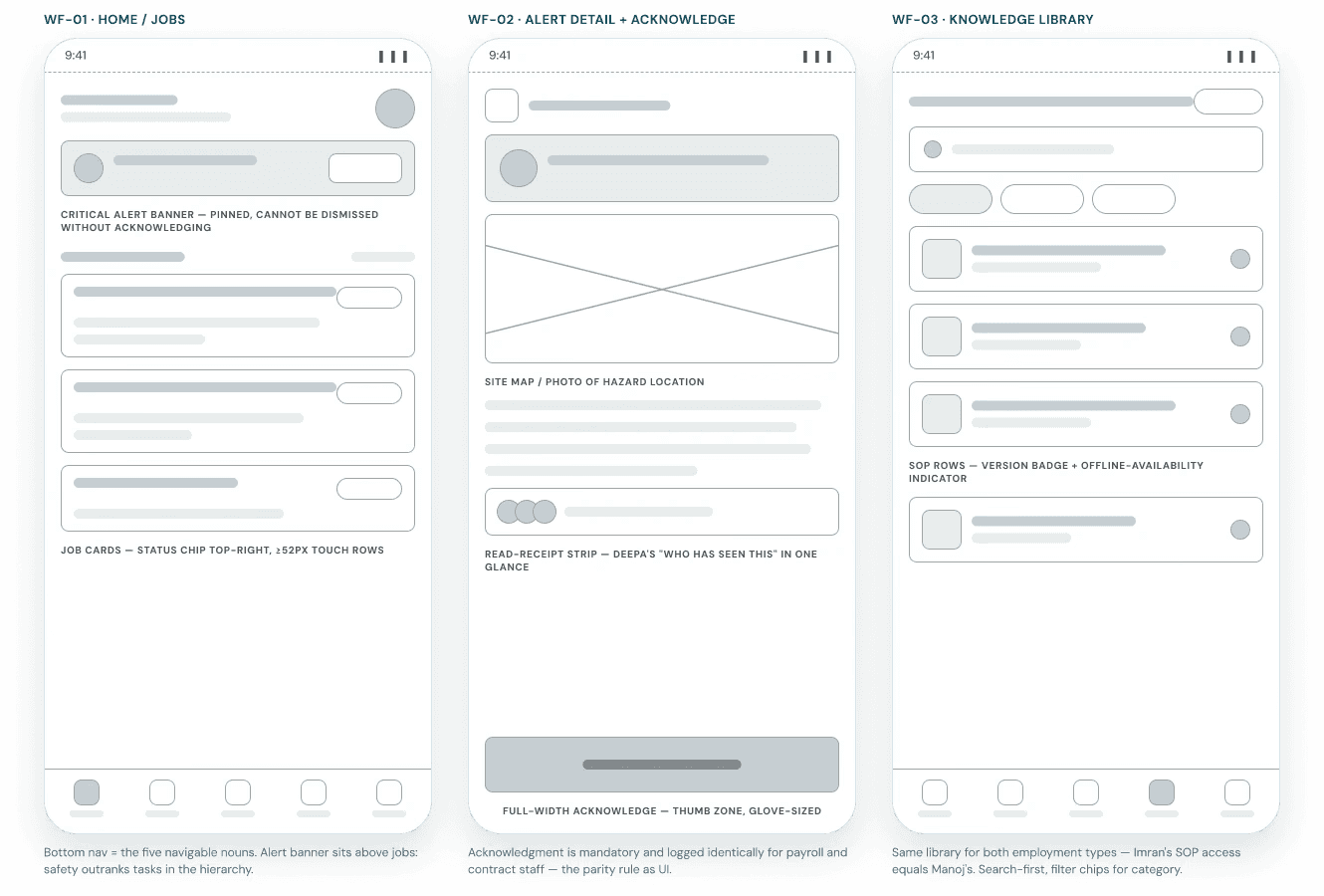


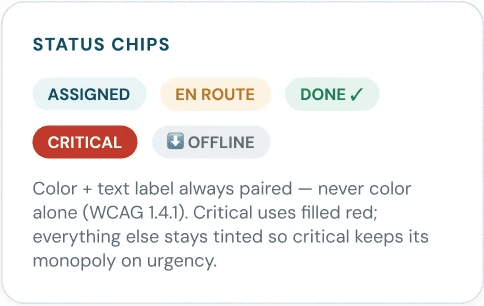
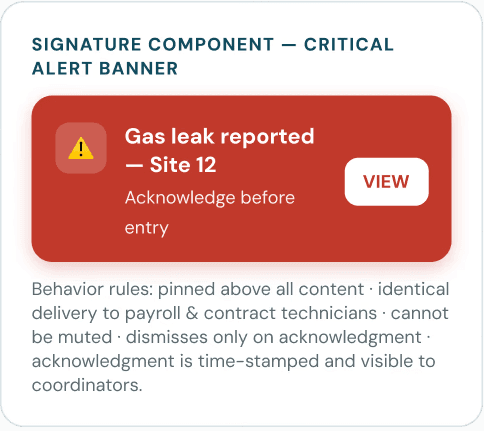


UI Design Components

Hi-fidelity Screens


Validation
Top finding: the glove-friendly one-tap "Acknowledge" invited accidental confirmation of safety alerts (severity 4). The same design choice that made the button glove-friendly made it dangerously easy to acknowledge by accident - accessibility and error prevention were fighting each other. It was redesigned as slide-to-acknowledge with undo option.
Second finding: no offline sync-status on jobs and acknowledgments despite patchy-connectivity users (severity 3) → added queued-sync states.

Before & After Validation


Key Outcomes
Usability validation surfaced two critical issues before build -
A safety-alert acknowledgement that could be triggered accidentally (severity 4) was redesigned pre-development with slide-to-acknowledge and a chance to undo within 5 seconds.
Missing offline sync states for low-connectivity users (severity 3) was redesigned pre-development with queued-sync states.
Learnings
Design decision should be backed by research.
Simplicity is critical in field operations.
Information Architecture shapes the user experience.
Design is an iterative process.
Validation strengthens design decisions.
Reflection
This project strengthened my understanding that successful UX design begins with understanding people rather than designing screens. It gave me the opportunity to apply the complete UX process, from research and information architecture to wireframing, prototyping, and validation, while designing for a real operational challenge.
Areas for Improvement
If I had additional time and access to users, I would validate the assumptions through field research, refine the personas based on observed behaviour, and measure usability using task completion, error rates, and satisfaction metrics.